

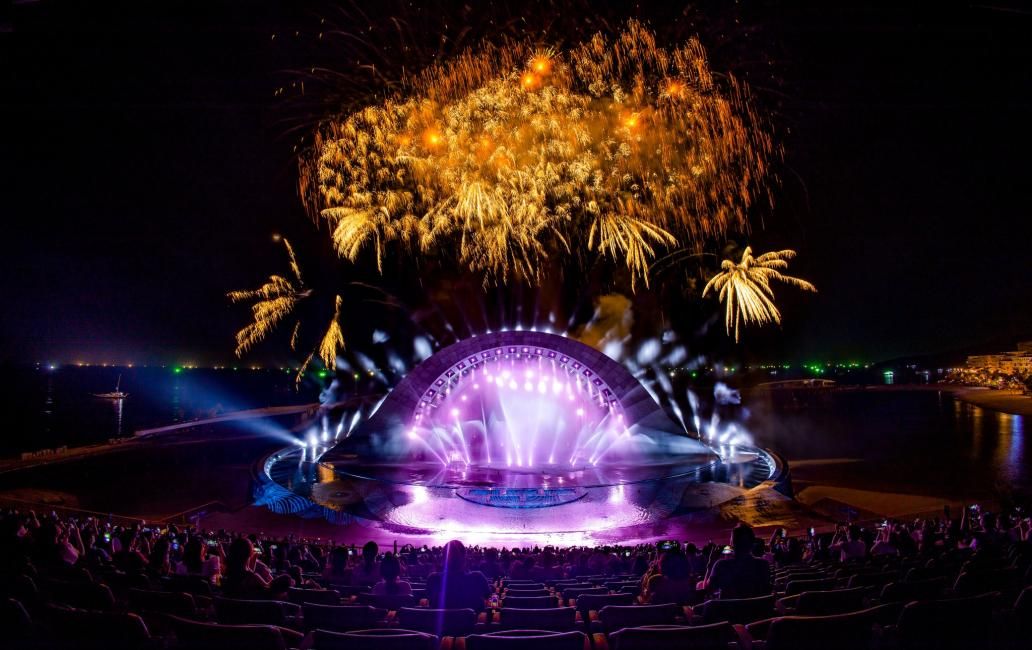
From around 6:00 PM, the terracotta-hued buildings of Sunset Town begin to glow. Visitors make their way from Kiss Bridge, the square and seafront restaurants toward the performance venue. The breeze still carries the salt of the ocean, but the atmosphere feels distinctly different from the afternoon: conversations soften, eyes turn toward the three monumental arches, and everyone waits for the water ahead to become the backdrop of a story.
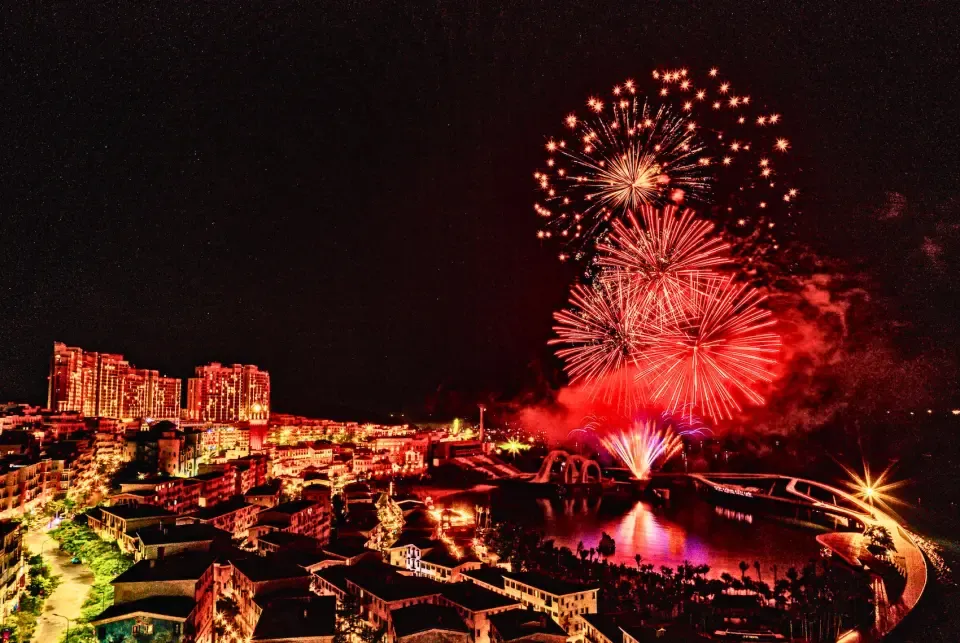
Kiss of the Sea is not the kind of performance to catch casually while strolling past. It is designed as the grand finale to an entire evening in southern Phu Quoc. With the right timing, visitors can watch the sunset, enjoy dinner, walk along Kiss Bridge and then take their seats just as the town behind them begins to shimmer after dark.
The show begins with layers of light sweeping across the sea and three projection arches rising within the open-air setting. From the grandstand, the story seems to unfold not on a conventional enclosed stage, but across the entire horizon.
The narrative follows Mok, a young man from Earth, and Kim, a girl from a distant planet. Their encounter soon draws them into cosmic upheaval, dramatic confrontations and a journey to protect life itself. The story unfolds through the movements of performers, imagery projected onto water screens, music and ever-changing layers of special effects.
There is little dialogue for audiences to follow word by word. Instead, much of the emotion is conveyed through colour, percussion, dramatic aerial appearances and the movement of water. This visual language makes the main storyline accessible even to international visitors, children and those experiencing the show for the first time.
A Stage Set Against the Open Sea
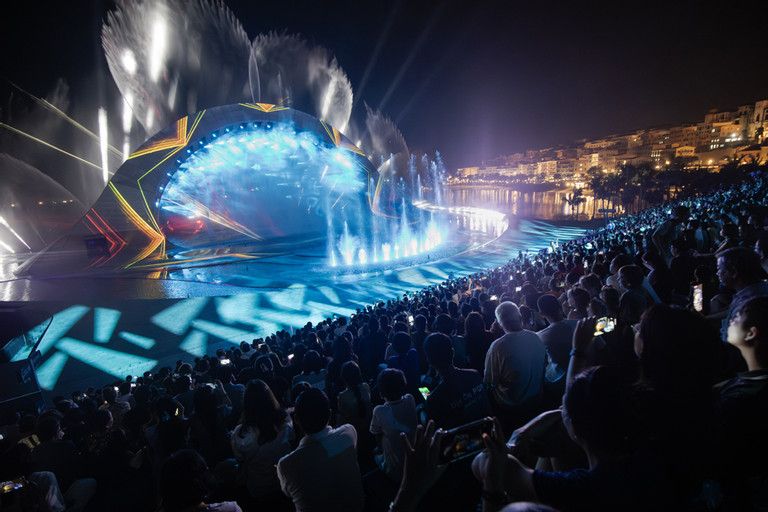
The performance space sits directly by the shoreline, allowing the ocean itself to become part of the stage. Three consecutive projection arches give the visuals a remarkable sense of depth, while the sea breeze, mist and sound of the waves create a physical immersion that is difficult to replicate inside a traditional theatre.
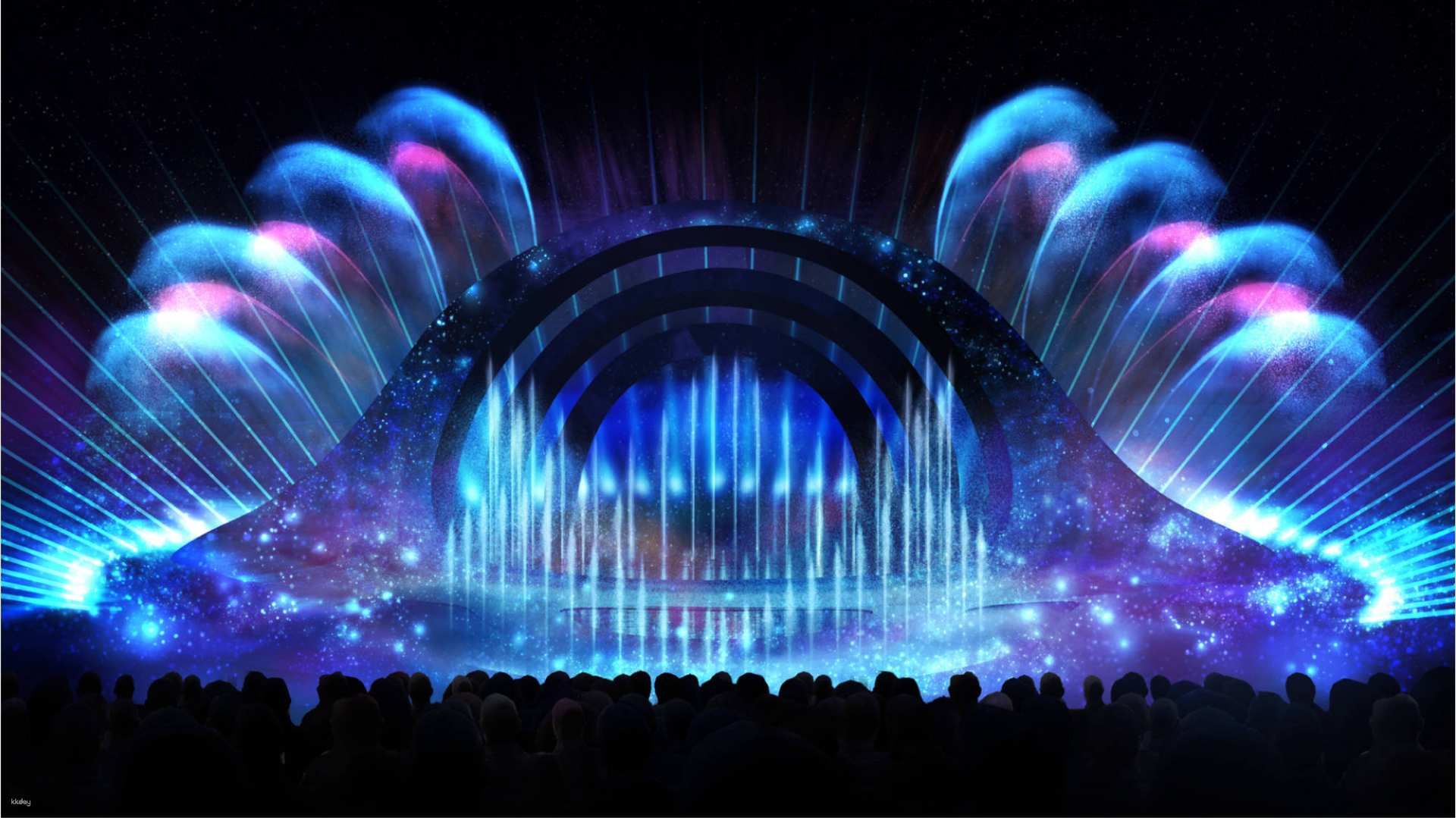
Lasers, projection mapping, water effects, lighting, fire, music, stage movement and fireworks are synchronised down to each beat. At times, before the eye has fully absorbed an image on one projection arch, a burst of water or flame appears from another direction. For this reason, a central seat at a moderate distance often provides the most balanced view of the entire spectacle.
International artists do far more than dance across a conventional stage. They appear within illuminated rings, soar through aerial rigging systems and perform action sequences precisely choreographed with the show’s visual effects. Although the grandstand can accommodate more than 5,000 spectators, the constant movement across the performance space allows many scenes to retain a surprisingly immediate and immersive quality.
After the story reaches its climax, fireworks erupt over the sea and continue for several minutes. It is often the moment when phones rise across the grandstand, yet the spectacle is arguably best experienced with the naked eye: light reflecting across the water, sound reverberating from the surrounding architecture and the entire audience briefly illuminated beneath the night sky.
The grandstand faces directly toward the marine stage. Seats in the central section, around the middle rows, generally offer the most balanced perspective: far enough away to take in all three projection arches, yet close enough to follow the performers’ movements.
Sitting very close to the stage offers a clearer view of the artists, but it can make the overall visual effects harder to appreciate. Depending on the wind, guests in the front may also feel some of the water mist.
Seats toward either side still provide a good view of the performance, although the alignment of the three arches and the fireworks may feel less symmetrical than from the centre.
Families travelling with young children or elderly guests may want to choose seats with convenient aisle access and avoid areas that require climbing too many steps.
Those sensitive to loud sounds may also consider bringing soft earplugs, as some sequences include explosive effects and high sound levels.
4:30–5:00 PM: Arrive at Sunset Town, stroll around the square and find a good spot to watch the sunset.
5:30–6:30 PM: Explore Kiss Bridge or take photographs while the late-afternoon light is still soft.
6:30–8:00 PM: Have dinner. Choosing a restaurant near the performance venue will help minimise travel time later in the evening.
8:00–8:30 PM: Walk to the ticket checkpoint, prepare your QR code and locate your seats.
9:00 PM: Enjoy Kiss of the Sea. After the show, consider remaining in your seat for a few extra minutes to avoid leaving at the same time as the main crowd.
If you plan to combine the evening with Symphony of the Sea, it is worth starting earlier. The two performances offer distinctly different experiences: one brings together sport and artistic performance on the water, while the other tells a multimedia story across a spectacular marine stage.
Check the performance schedule on the day of your visit, as outdoor shows may be adjusted when weather conditions are unsuitable.
Bring a light jacket or scarf. The sea breeze can feel cooler than expected at night, particularly for young children.
Avoid carrying bulky luggage, as the entrances and stairways around the grandstand can become crowded before and after the performance.
Try not to use flash photography or hold your phone too high, as this may obstruct the view of guests seated behind you.
Keep your electronic ticket until you have completely left the venue, particularly if your ticket package includes additional sightseeing or dining benefits.
The show is well suited to couples, groups of friends, families with children and travellers looking to spend a complete evening in southern Phu Quoc. Younger visitors are often captivated by the lights, flames and fireworks, although parents should take into account the loud sound effects, the relatively late performance time and the possibility of children becoming tired after a full day of activities.
Even those who are less interested in following the storyline can appreciate the sheer scale of the stage and the sophistication of its production technology. Conversely, travellers looking primarily for a performance rooted in traditional local culture may find Kiss of the Sea to be a more contemporary world of entertainment rather than an intimate portrait of island life.
The show generally starts at 9:00 PM. Operating schedules may vary depending on the date and weather conditions, so visitors are advised to arrive 45–60 minutes before the performance.
Its most distinctive features include an open-air stage set against the sea, three consecutive projection arches, an integrated system of water, fire, lasers and projection mapping, more than 60 international performers, and a spectacular fireworks finale.
Phu Quoc has long been remembered for its turquoise waters and slow, lingering sunsets. Kiss of the Sea introduces another rhythm to the island: once the sun has disappeared beyond the horizon, there is still a reason to remain by the shore, take a seat beneath the night sky and watch the sea itself come alive with light.
When the final firework fades, the crowds begin to leave the grandstand and the golden streets of Sunset Town reappear ahead. What remains is more than the memory of having watched a show. It is the feeling of having witnessed a piece of Phu Quoc’s night-time sea transformed, for a moment, into an extraordinary stage.